The OmniLand
Arcology
A sovereign infrastructure partnership proposal for 45,000 hectares of Vancouver Island, British Columbia — where the built environment and the natural one are genuinely integrated.
Executive Summary
Every year, Vancouver Island loads its non-recyclable waste onto barges and ships it across the Salish Sea. The Cowichan Valley Regional District. The Regional District of Nanaimo. Hundreds of thousands of tonnes of material making a 400-kilometre journey to landfills in the BC interior — at a cost measured in dollars per tonne, compounding annually, borne entirely by the communities producing it. This is not a logistical inconvenience. This is the permanent, settled solution that every level of government has accepted as normal.
Meanwhile, the Cowichan and Koksilah watersheds supply drinking water to tens of thousands of Island residents. Their headwaters run through unprotected forestry land, a single permit cycle away from the next clear-cut. And when the grid falters — or simply does not reach — communities and industrial operations across the Island run on diesel. Not as a backup. As the plan.
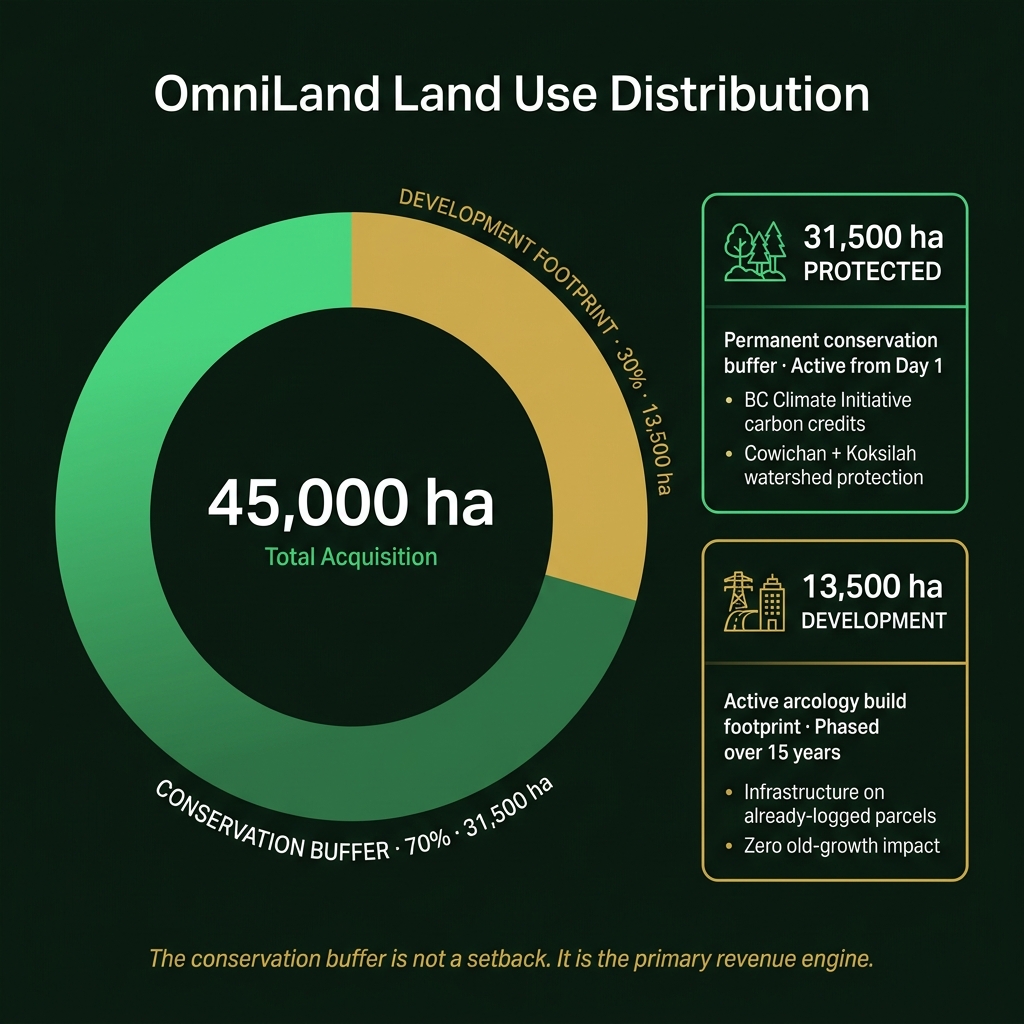
OmniLand ends all three. It is a 45,000-hectare sovereign infrastructure project on Vancouver Island — not a development proposal, but a regional utility in the form of a living arcology. A WTE Plasma Forge that processes Vancouver Island's residual waste on-island and feeds clean electricity directly into the BC grid. A 31,500-hectare permanent conservation buffer (70% of total land, protected from Day 1) that guards the Cowichan and Koksilah headwaters and generates BC Climate Initiative carbon credits. And a world-class arcology destination — funded by a two-phase, 7-year, $877M CAD sustainable timber harvest on its own 30% development footprint — The build funds itself. The surplus goes back to the land.
"When the most ecologically rich island in Canada ships its garbage across the ocean, that is not an infrastructure gap. That is infrastructure abandoned. And the opportunity it leaves behind is equal to the failure."
— OmniLandThe Five Pillars
Vancouver Island: The Territory
The OmniLand area of interest spans the foothills and watersheds between Nanaimo and Duncan on Vancouver Island — ancestral Hul'q'umi'num territories, held primarily by Mosaic Forest Management. The 45,000-hectare acquisition target encompasses the geological richness, First Nations connection, and decades of industrial logging activity that converge here: much of what needs to be built can be positioned on land already cleared by logging operations, and every infrastructure project strengthens communities that have endured a century of extraction.
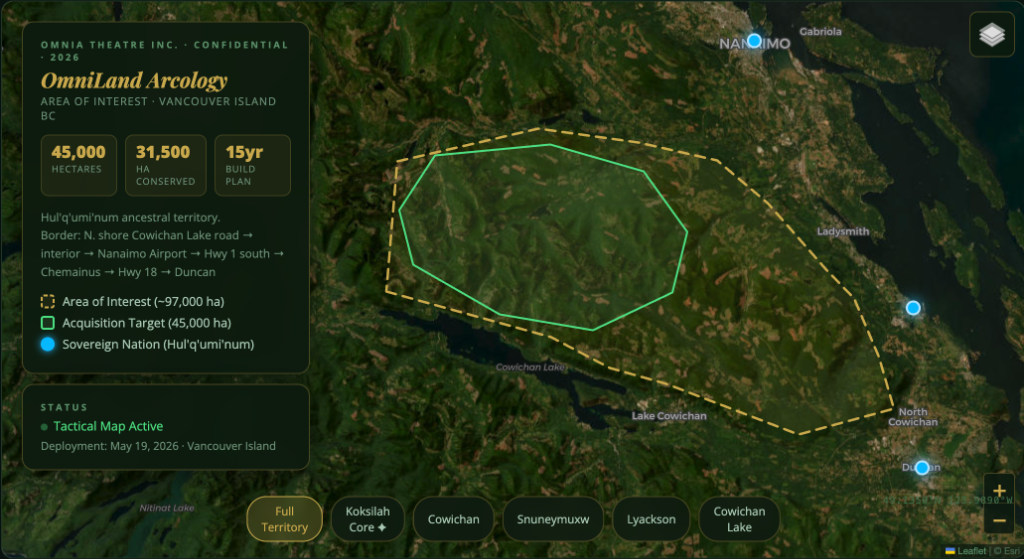
Fig. 0 — OmniLand Area of Interest: 45,000 ha between Nanaimo and Duncan, Vancouver Island BC. Dashed amber polygon = area of interest boundary (~97,000 ha search corridor). Green polygon = 45,000 ha acquisition target (Cowichan Lake north shore). Blue dots = Hul'q'umi'num sovereign nation locations. 31,500 ha (70%) designated permanent conservation buffer. Note: polygon boundaries are schematic approximations only and do not represent legally defined property or territorial borders.
The Hul'q'umi'num Nations
The territory sits within the traditional lands of three Coast Salish peoples who share the Hul'q'umi'num language and a deep connection to the land's rivers, forests, and ocean — a relationship spanning thousands of years before European contact.
These Nations have maintained stewardship of these ecosystems through centuries of colonial disruption — defending treaty rights, protecting watersheds, and advocating for the return of ancestral territories.
The OmniLand Arcology does not propose to develop on First Nations land. It proposes to partner with sovereign Nations to bring infrastructure that makes their land permanently more valuable, more protected, and more economically sovereign than any corporate logging operation could ever offer.
The Colonial Extraction Problem
For over a century, Vancouver Island's forests have been managed by corporate interests whose primary directive is timber volume extraction. The result is predictable: locked public access gates, disrupted watersheds, PR disasters, and communities watching their backcountry be industrially consumed.
The Koksilah watershed — at the heart of the OmniLand site — has become a flashpoint. Industrial logging operations have threatened summer water flows critical to the Cowichan River's salmon populations, creating a direct confrontation between corporate operations and First Nations rights.
The Precedent
In May 2024, the BC Government purchased 312 hectares at Skutz Falls from Mosaic Forest Management for $8.55M and returned it to Cowichan Tribes and Lyackson First Nation. This proves Mosaic will concede land — and reveals the price of a credible change in direction for them.
Geological Foundation
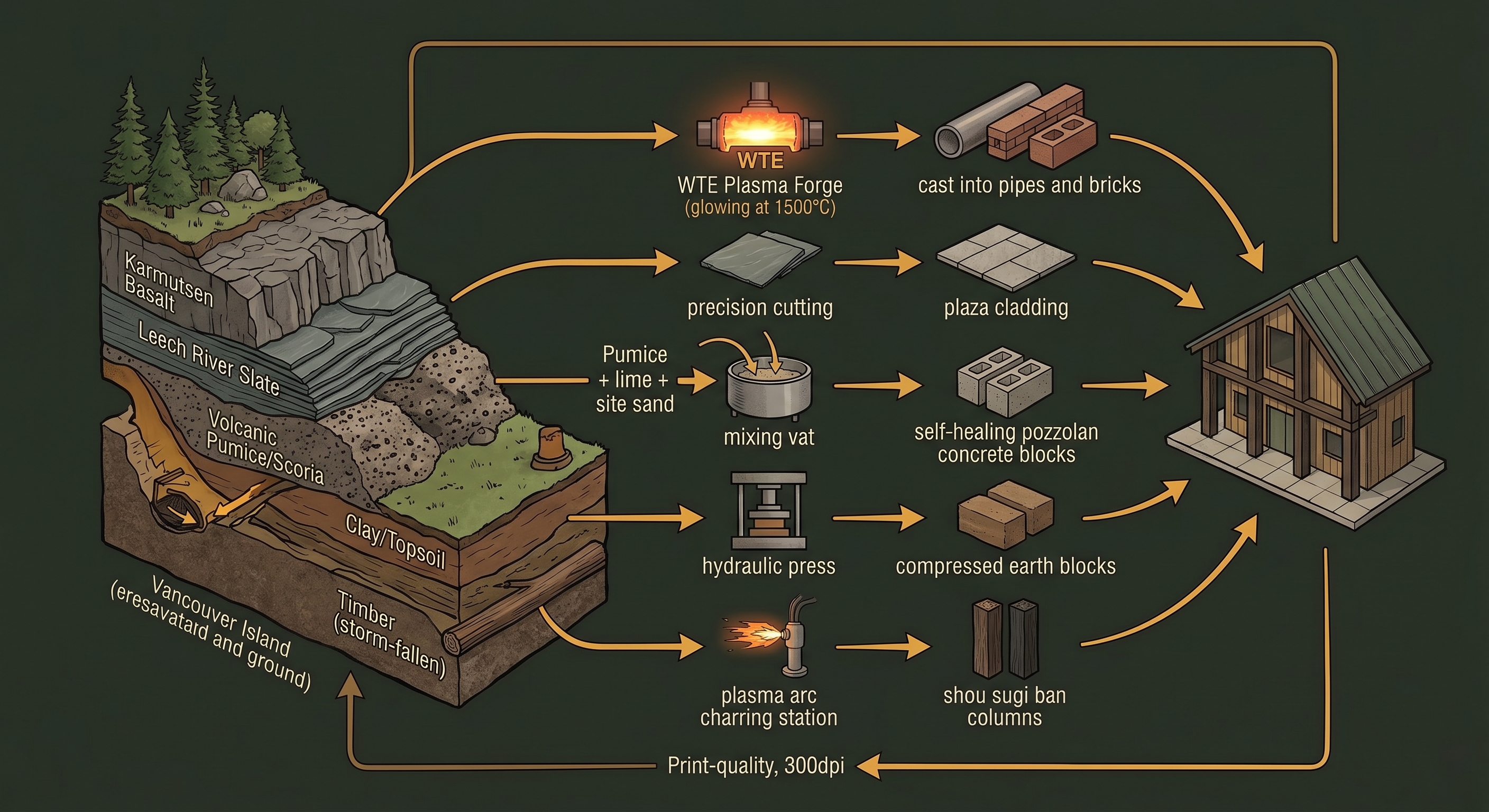
Vancouver Island is not merely beautiful — it is geologically significant. The Karmutsen Formation and the Leech River Complex provide the raw materials for an architecture that will stand for ten thousand years — quarried from the very ground it rises from.
The Mosaic Opportunity
Mosaic Forest Management holds the majority of the land within the OmniLand area of interest. Their current position — and the tensions surrounding it — create a meaningful opening for a partnership conversation built on mutual benefit.
Their Position
Mosaic is a sophisticated forestry company with one acknowledged progressive achievement: the BigCoast Forest Climate Initiative, through which they have deferred 40,000 hectares of logging to generate carbon credits for sale. This proves they understand the carbon credit revenue model — and that they are capable of operating it at scale.
However, they are simultaneously facing a PR crisis of their own making. They have been locking access gates to public backcountry lands across Vancouver Island, citing safety and wildfire risks. Local communities, wilderness advocates, and First Nations view this as corporate land-hoarding — and the optics have forced them to hire external PR consultancies to manage the outrage.
Their Redemption Frame
Mosaic is the villain of BC's conservation community right now, and they know it. The OmniLand Arcology offers them a genuine path out: the ability to point to a 45,000-hectare eco-sovereign partnership as proof they are investing in the Island's future rather than locking gates and managing outrage. Critically, infrastructure goes up first on already-logged and cleared parcels — land with no old-growth value and no ecological sensitivity. Mosaic gets to point to productive use of degraded land, a visible First Nations partnership, and a story about the future of forestry. That is a credible and meaningful change in direction for their investors and stakeholders.
Strategic Use Points
| Factor | Our Advantage |
|---|---|
| BigCoast Carbon Initiative | Proves they understand carbon revenue — we offer a structurally similar model, as a sovereign partnership rather than a corporate offset program, on higher-yield coastal temperate rainforest |
| Skutz Falls Return | Proves they will concede land when a meaningful public narrative and genuine partner support are present |
| Koksilah Watershed Crisis | We resolve the watershed stewardship crisis with a long-term conservation model, with First Nations as co-architects |
| Public Gate Closures | Our open arcology models a land stewardship approach their stakeholders are asking for |
| First Nations Alliance | United Nations partnership demonstrates the breadth of community support for this vision |
The Conversation
We approach Mosaic Forest Management as a partner, not an adversary. With documented First Nations support, government grant confirmation, and institutional investor interest, we bring a proposition with genuine economic and reputational value for both parties. Mosaic gains a credible path toward the land stewardship narrative their stakeholders are asking for — while becoming a founding partner in one of the most significant sustainable land projects in Canadian history. We extend this opportunity in good faith.
The Thermodynamic Engine
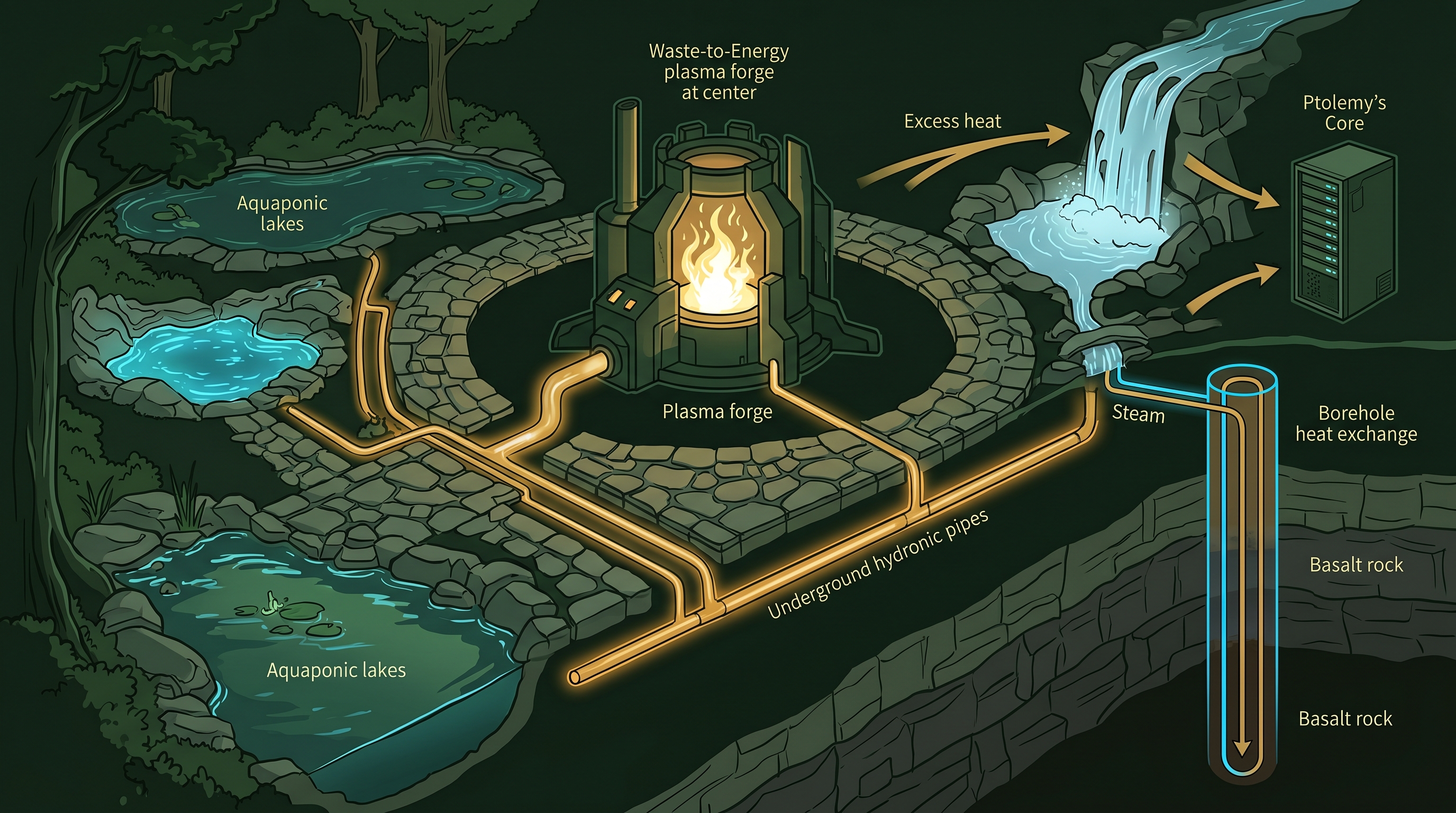
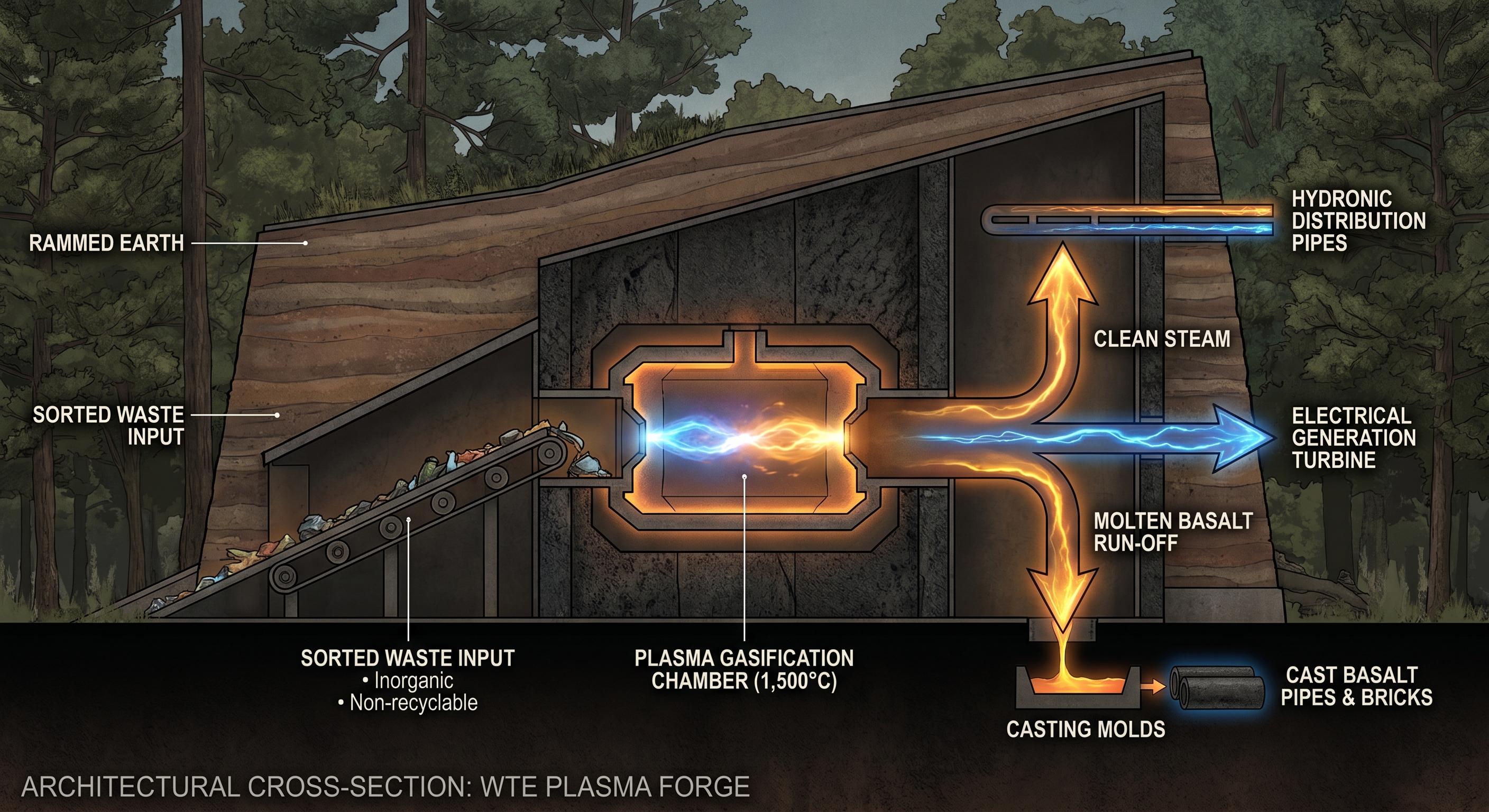
The Plasma Forge is not sized to process only what Demere produces — it is built as a regional public utility for Vancouver Island. Every municipality on the Island currently exports non-recyclable waste to mainland landfills or burns it inefficiently. The Forge ends that dependency. Sweden's Stockholm Exergi model demonstrated that a single combined heat-and-power WTE facility can serve 250,000 homes. Japan operates over 1,300 WTE facilities nationwide — including dedicated plasma gasification plants like the Mihama-Mikata facility (operational since 2002) — achieving 99%+ waste diversion from landfill in urban centers. The OmniLand Forge is built on this proven model: zero toxic emissions, no landfill dependency, revenue-positive at regional scale. Its thermal output then powers the arcology's closed-loop energy system — every pathway snow-free, every plaza dry, every experience running year-round regardless of Vancouver Island's legendary rain. Not by fighting nature — by partnering with it.
Hydrological Alchemy
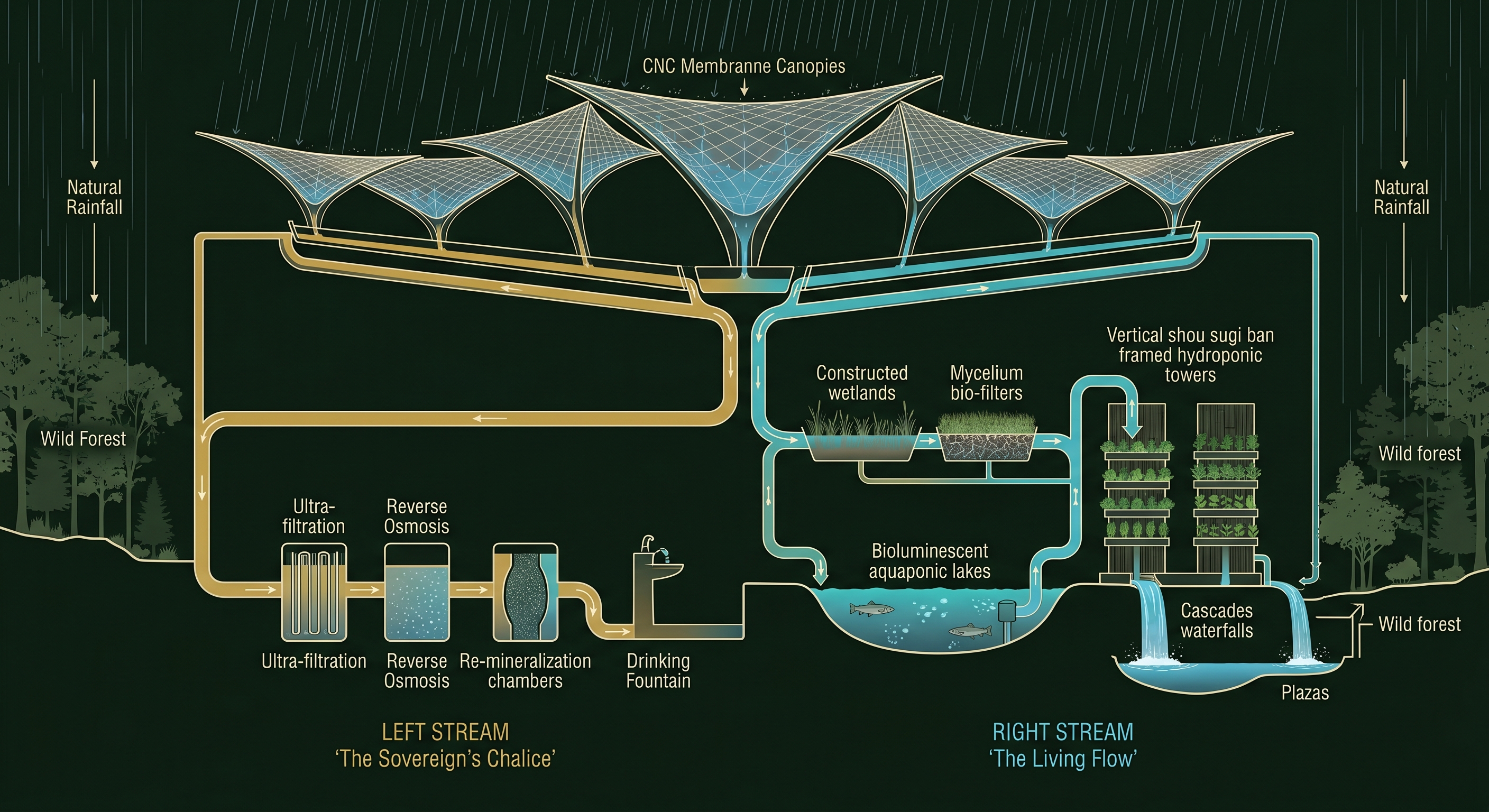
Vancouver Island receives over 1,500mm of rainfall annually. This is not a problem to be managed — it is the lifeblood of the entire ecosystem. The Arcology captures, stratifies, and cycles every drop through a dual-stream watershed system that serves both the human vessel and the living biosphere.
Stream 1: The Sovereign's Chalice
A fraction of captured stormwater is routed through advanced filtration, reverse osmosis, and UV purification — stripped of all impurities.
Before it reaches a guest's lips, it is actively re-mineralized with optimized ratios of calcium, magnesium, and potassium — creating perfect, alkaline, cellular-hydrating drinking water. Every tap in the arcology delivers this.
Stream 2: The Living Flow
The vast majority of captured stormwater passes through advanced bio-filters — constructed wetlands and mycelium networks — removing pathogens while intentionally retaining nitrogen, dissolved CO₂, and native minerals.
This "Living Water" cycles through aquaponics facilities where native Rainbow Trout and Sturgeon infuse it with rich nitrates. The highly oxygenated water then feeds vertical hydroponic towers, powers evaporative cooling, and fills the eternal waterfalls of the Cascade Grounds before returning to the lakes.
The Unfiltered Wild
Any rain falling outside our architectural footprint — directly onto the forest canopy — is left completely untouched by our systems. The deep wilderness receives the exact natural nutrient cycle it has relied upon for millennia. We do not reach into the wild. We work at its edges, and we honor its interior completely.
The Broader Island Watershed Opportunity
Vancouver Island's chronic summer watershed depletion — which threatens Cowichan River salmon runs every dry season — is a systemic problem with no current solution. The arcology's advanced constructed-wetland bio-filtration and controlled-release reservoir management, piloted within our footprint, offer a scalable model for the broader island watershed. The water infrastructure we build is a proof-of-concept for a regional stewardship program that extends well beyond our borders.
Resource Architecture: The Bones of Demere
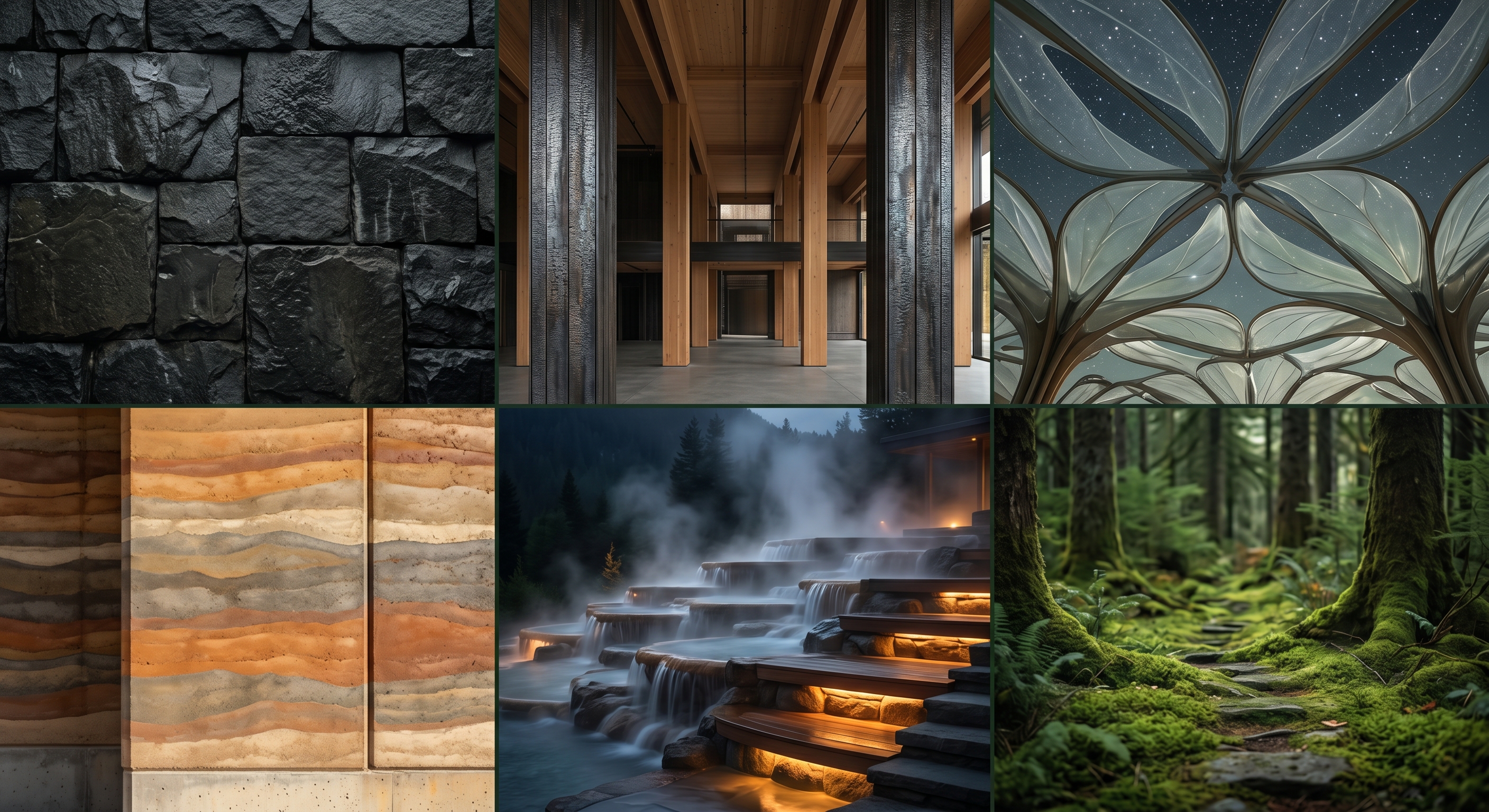
The Arcology contains zero synthetic facades. Zero fiberglass. Zero Portland cement. Every material is hyper-local, excavated from the site itself, and processed using the energy generated on-site. If you touch a stone wall in Demere, it is stone. If you lean against a timber column, it is solid old-growth cedar. The Arcology is built from the material of Vancouver Island itself.
Carbon, Climate, & Zero Waste
The OmniLand Arcology is not a carbon-neutral project. It is a carbon-negative one. The 31,500-hectare conservation buffer — 70% of the total land — is not idle space. It is the primary revenue engine of Phase 1, generating carbon credit income through BC's Climate Initiative while preserving the ecological integrity that makes the entire arcology model possible.
BC Climate Initiative Framework
British Columbia's offset system allows landowners who protect forests from logging to generate and sell carbon offsets under the BC Greenhouse Gas Industrial Reporting and Control Act (GGIRCA). Forest Carbon Offsets are generated based on the difference between actual carbon sequestration in the protected forest versus what would have occurred under a "business as usual" logging scenario.
Comparable Precedent: Mosaic's own BigCoast Forest Climate Initiative deferred 40,000 hectares of logging to generate forest carbon credits. This is already proven in the exact jurisdiction and with the same landowner we are in conversation with.
Our 31,500-hectare buffer sits on coastal temperate rainforest — one of the highest carbon-density forest types on Earth — generating superior carbon credit yields per hectare compared to the interior parcels in Mosaic's BigCoast program.
The Zero-Waste Materials Charter
- Zero Portland cement in any structural element
- Zero synthetic fluoropolymers (no ETFE, no fiberglass)
- Zero toxic adhesives — all binding via Lignin Bio-resins
- Zero permanent plastic in any architectural component
- Zero chemical sealants on timber (plasma-arc Shou Sugi Ban only)
- Zero toxic glycols in geothermal loops (Potassium-Betaine Matrix)
- 100% of organic waste → Great Compost → topsoil fed to old-growth Red Cedars
- 100% of inorganic waste → WTE Plasma Forge → energy + cast basalt
The Alliance We Are Building
OmniLand does not happen without a coalition. Five partners must come together — each bringing something no one else can. Three Nations whose sovereignty over this land predates every other claim. A forest management company that holds the keys to 45,000 hectares of Vancouver Island's most biodiverse territory. And the creative company that holds the vision that makes all of it matter. This is the alliance we are building.
"Built for the people whose territory it stands on."
— OmniLand Strategic Position"nuts'a'maat shqwaluwun" — working together with one mind, one heart, one spirit.
The Precedent: Mosaic's own BigCoast Forest Climate Initiative deferred 40,000 ha from harvest in exchange for carbon credits. We are proposing the same logic at 45,000 ha — with a generation-defining destination attached to the value it creates. We extend this opportunity in good faith.
Motto: "Empowering creative minds in a world of technology."
The Grand Assembly Strategy
The goal is not five separate conversations. It is one unified coalition. When the Cowichan, Snuneymuxw, and Lyackson Nations stand together in support of the Arcology, the conversation with Mosaic is fundamentally changed. When Mosaic and the Nations align, the conversation with government grant programs (CIB, CleanBC, IAFSI, SCAP) is structurally de-risked. And when institutional capital sees First Nations unity, a land-management partner, government grant confirmation, and Omnia Theatre's proven technology — the investment decision becomes inevitable. The Alliance is not a milestone. It is the mechanism.
The 15-Year Projected Timeline
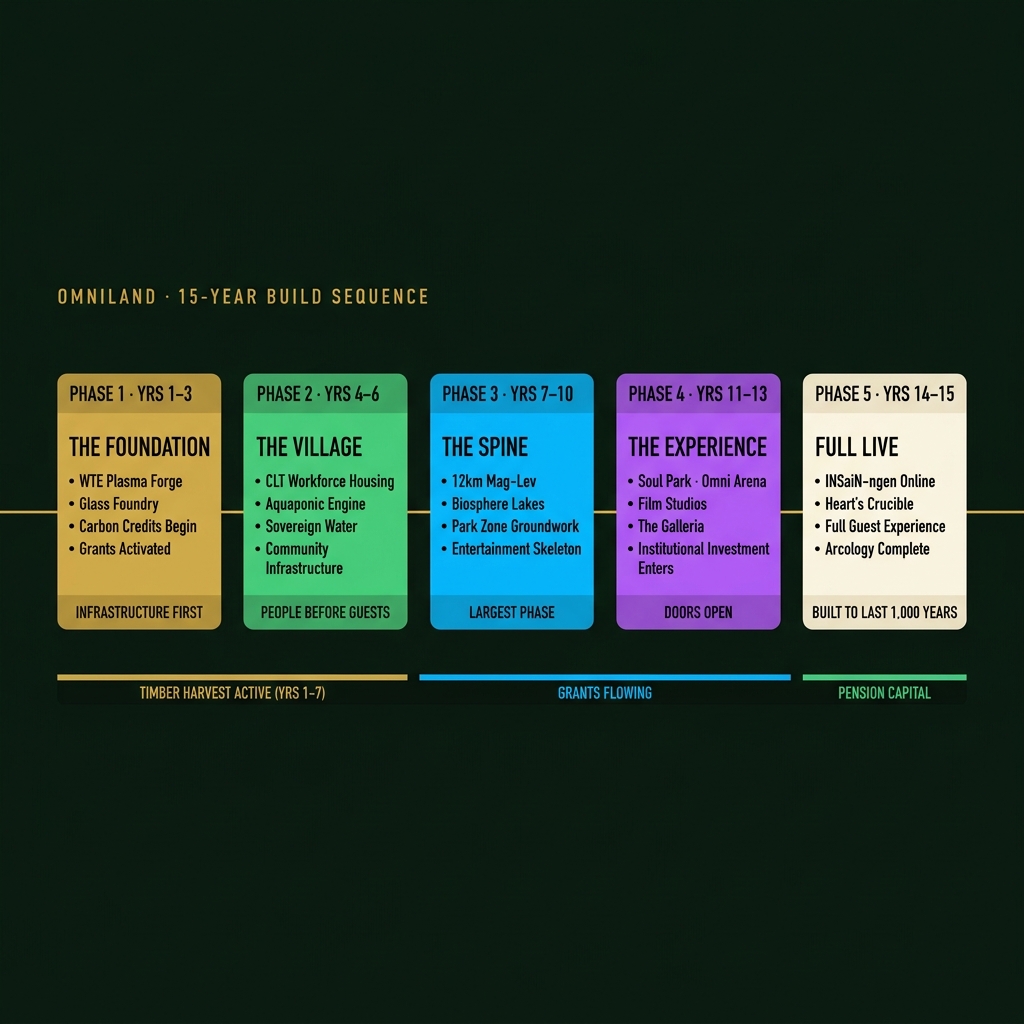
The Arcology is built in five strategic phases across 15 years. Each phase funds the next. Infrastructure comes first — because infrastructure generates the grants, the carbon credits, and the industrial revenue that makes everything else possible. Entertainment follows infrastructure. The vision follows the foundation. Fifteen years because this is the most significant infrastructure project in Vancouver Island's history, and it deserves to be built as though it will stand for a thousand.
The Parks of Demere
Four sovereign parks. One continuous initiation. Every guest who enters Demere follows the same arc — from surrendering the modern world in Maya (The Spirit Park), through Heart's Crucible and the Jungle Step (The Body), into Atman (The Mind) — and each night, arriving at the Cascade Grounds to rest, celebrate, and begin again. Each park is thermodynamically integrated with the Arcology's systems: the weather, the warmth, the water — all of it is alive.
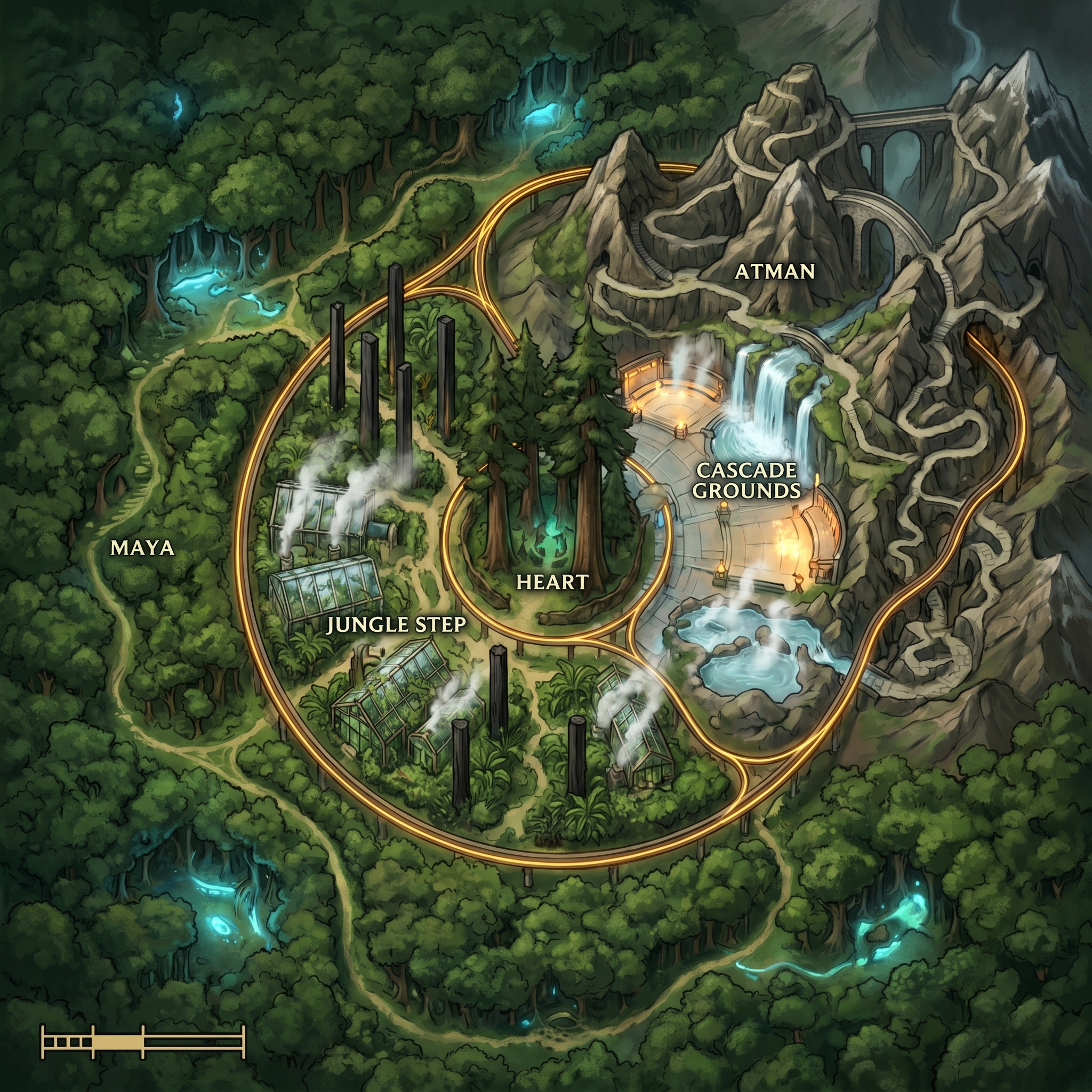
The counterweight to modern life. Maya operates as a strict sequential pilgrimage — there are no shortcuts, no Resonance Tiers. Surrender is universal.
The Elemental Pilgrimage:
🌲 Forest (Grounding) — Barefoot on responsive moss pathways. Deep acoustic transducers emit the 7.83Hz Schumann Resonance, flushing anxiety from the nervous system.
🔥 Fuego (Crucible) — Traditional Temascal sweat lodges honoring North American aboriginal traditions. Copal and sage over superheated volcanic stones.
💧 Flow (Cleansing) — Geothermally heated soaking pools (40°C WTE-loop) and cold plunges from natural winter aquifers — zero artificial refrigeration required.
🏔️ Fuji (Breath & Mastery) — High-altitude breathwork academy. Stone doors open only when the group successfully regulates their heart rates.
⚡ Flash (The Spark) — Faraday Cage arena with musical Tesla Coils. Raw plasma arcs overhead.
☀️ Sol & Luna — The silver-lit underground labyrinth of Luna, then emergence into Sol — a soaring glass cathedral flooding guests with prism-refracted sunlight (full-spectrum Oriana LEDs in winter).
The Jungle Step: A perennial tropical biome maintained by WTE heat retention. The deep forest soil here is never allowed to cool — creating a year-round summer interior regardless of Vancouver Island's winters.
The Pulse: A cooperative water coaster propelled by passenger effort through 38°C water from the WTE cooling loop. In winter, it breathes massive clouds of visible steam into the cold air — spectacular from any vantage point in the park.
The Nourishment Matrix: Hydroponic hanging gardens frame the dining zone. The heat from guests' open cooking fires is captured by Arcane exhaust hoods and fed back into the WTE pre-heating loop — the guests' own warmth powers the next cycle.
The Daedalus Grid: A shifting labyrinth on a Cellular Radiant Matrix. If INSaiN-ngen detects hyperthermic panic, it cuts steam beneath the guest — a localized chill — while acoustics guide compression breathing.
The Cryptex: Narrative escape rooms where raw WTE steam lines and icy aquifer water run through the walls. Guests must redirect thermodynamic valves to stabilize the room temperature.
The Lotus Matrix: Gamified meditation chambers locked at exact human skin temperature (33°C) — the sensation of the room itself disappears.
The Synapse Circuit: High-speed Mag-Lev pods in Faraday Hulls that pulse the 7.83Hz Schumann Resonance inside while generating an electromagnetic slipstream that repels rain externally.
The Naming Sanctum: The climax — the guest's True Name is calculated. Air pressure perfectly balanced. A mathematically determined breeze carrying the scent of ancient cedar.
The Eternal Festival: Holographic Living Spectres — Demere's ancient family — walk the promenades. Kinetic CNC canopies shelter the plazas. Radiant hydronic pathways keep ambient heat high enough for barefoot dancing in January.
The Arenas of the Wardens: Melody's acoustic canyon (sealed by Air Curtains), Affin's domain (evaporative cooling), Herus and Krishe's open-air arenas with focused infrared heating.
The Empyrean Terraces: Cascading hot springs heated by WTE excess and the heat generated by Ptolemy's server banks beneath the Observer's Apex.
The Observer's Apex: Ptolemy's Omni-Intelligence Server Hub. Liquid-cooled by icy winter aquifer water. The Emperor's computations heat the hot springs and the streets of the city he governs.
The Show Caller: Every thermal event, every acoustic shift, every scent sequence — orchestrated by a single intelligence that treats the entire Arcology as one living performance. When a guest earns their True Name in Atman, INSaiN-ngen carries it through the Cascade Grounds and into every interaction for the rest of their stay.
Funding & Capital Structure
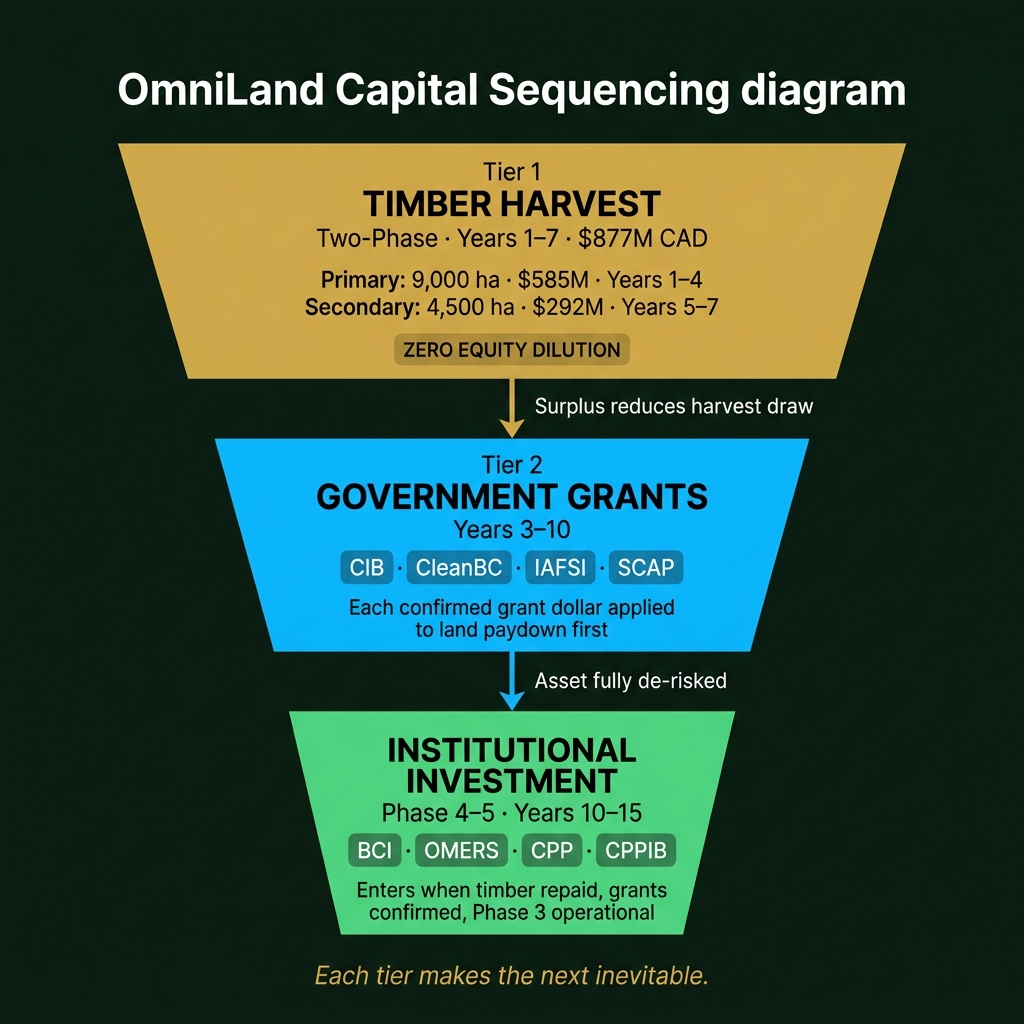
The OmniLand capital strategy is sequenced to maximize institutional use and minimize personal runway. The project is funded by a two-phase, 7-year sustainable timber harvest on its own 30% development footprint (13,500 ha): a primary harvest of 9,000 ha generating $585M in Years 1–4, followed by a secondary harvest of 4,500 ha generating ~$292M in Years 5–7. Together: $877M CAD in harvest capital — enough to fully fund Phase 1 and 2 CapEx, service every Mosaic land installment, and carry the project through Phase 3 construction without touching private equity. The surplus goes back to the land. Government grants (CIB, CleanBC, IAFSI, SCAP) reduce the harvest draw at every stage — each confirmed grant dollar is applied first to land paydown, then to forest recovery. → Full financial model & 15-year projections
| Program | Full Name | Relevance | Notes |
|---|---|---|---|
| CIB | Canada Infrastructure Bank | WTE plant, Mag-Lev spine, modular housing | Invests in revenue-generating infrastructure; WTE + housing are core mandates |
| CleanBC | CleanBC Industry Fund (BC Ministry of Energy) | WTE emissions reduction, geothermal, EV infrastructure | $75M+ annual fund targeting industrial emissions reduction in BC |
| IAFSI | Indigenous Agriculture and Food Systems Initiative | Aquaponics, hydroponic towers, Phase 2 agriculture | Crown-Indigenous Relations program targeting food sovereignty on traditional lands |
| SCAP | Strategic Community-Based Projects (INFC) | First Nations JV infrastructure, workforce housing | Infrastructure Canada program for Indigenous community infrastructure |
| BC Carbon Credits | BC Climate Initiative (GGIRCA) | 31,500-ha conservation buffer generates offsets | Comparable: Mosaic BigCoast = 40,000 ha deferred; our 31,500 ha is coastal temperate rainforest (highest carbon-density forest type on Earth) — comparable footprint with superior carbon yield per hectare |
The fundraising sequence is designed to manufacture institutional gravity. American VC interest validates the project for Canadian institutional investors. Canadian institutional validation completes the conclusion against Mosaic. Each step makes the next step easier — and the final step inevitable.
DISCLAIMER: Forward-looking financial information contained in this document is based on management estimates, comparable precedents, publicly available data, and internal projections. This information is provided for planning purposes only and does not constitute a guarantee of future results. Actual outcomes will depend on regulatory approvals, market conditions, partnership negotiations, and factors beyond the control of Omnia Theatre Inc. All projections should be independently verified before any investment decision is made.
Omnia Theatre: The Vision Behind the Land
OmniLand is not a real estate project with an Omnia Theatre logo attached. Omnia Theatre is a creative alchemy company in active development — and OmniLand is the physical home it is building for itself. Understanding Omnia Theatre is understanding why the OmniLand Arcology exists at all.
What Omnia Theatre Is
Omnia Theatre is a new-media company building a creative and entertainment operation at the intersection of technology, storytelling, and physical experience. Its motto: "Empowering creative minds in a world of technology."
The company's current development portfolio includes INSaiN-ngen (AI-powered film production tools), the Without Equal universe (a multi-novel, multi-platform IP), and OmniLand — the physical world that brings the Without Equal universe to life.
The Omni-Intelligence that governs OmniLand, the AI tools that power INSaiN-ngen, and the characters of the Without Equal universe are not separate products. They are one integrated creative ecosystem — each layer making the others more valuable, more defensible, and more significant.
INSaiN-ngen: The Technology Wedge
INSaiN-ngen is Omnia Theatre's AI production intelligence platform — a full-stack creative operating system for the film and entertainment industry. It automates production planning, script breakdown, and scheduling across departments; integrates with industry-standard workflows; and is built on the same AI engine that will power the guest experience in Demere. In investor conversations, INSaiN-ngen is the proof of execution: a deployable, revenue-generating product that demonstrates Omnia Theatre's ability to build sophisticated technology today — not just envision it for tomorrow.
In investor meetings, INSaiN-ngen is the proof of execution. The arcology is the scale of vision. Together, they represent something rare: a founder who can build software today and build cities tomorrow.
Without Equal: The IP Universe
Without Equal is the creative universe that OmniLand physically embodies. The park zones of Demere — Maya, Atman, the Cascade Grounds — are not theme park concepts invented for the arcology. They are the living world of Without Equal, made real. The IP depth of the universe is what distinguishes OmniLand from any other resort or theme park concept in the world: it is built on a mythology, not a brand.
The Demere Foundation
This document is the beginning of a conversation, not the end of one. The Arcology is a 45,000-hectare vision for what this island — and this world — can be. Built on science, on deep respect for the land, and on the belief that technology and nature have always belonged together.
"If humanity vanished tomorrow, the plastic theme parks would melt into toxic sludge in a century. Demere would stand for ten thousand years, slowly and beautifully returning to the earth that birthed it."
— Resource Alchemy & Architecture, OmniLand Design Philosophy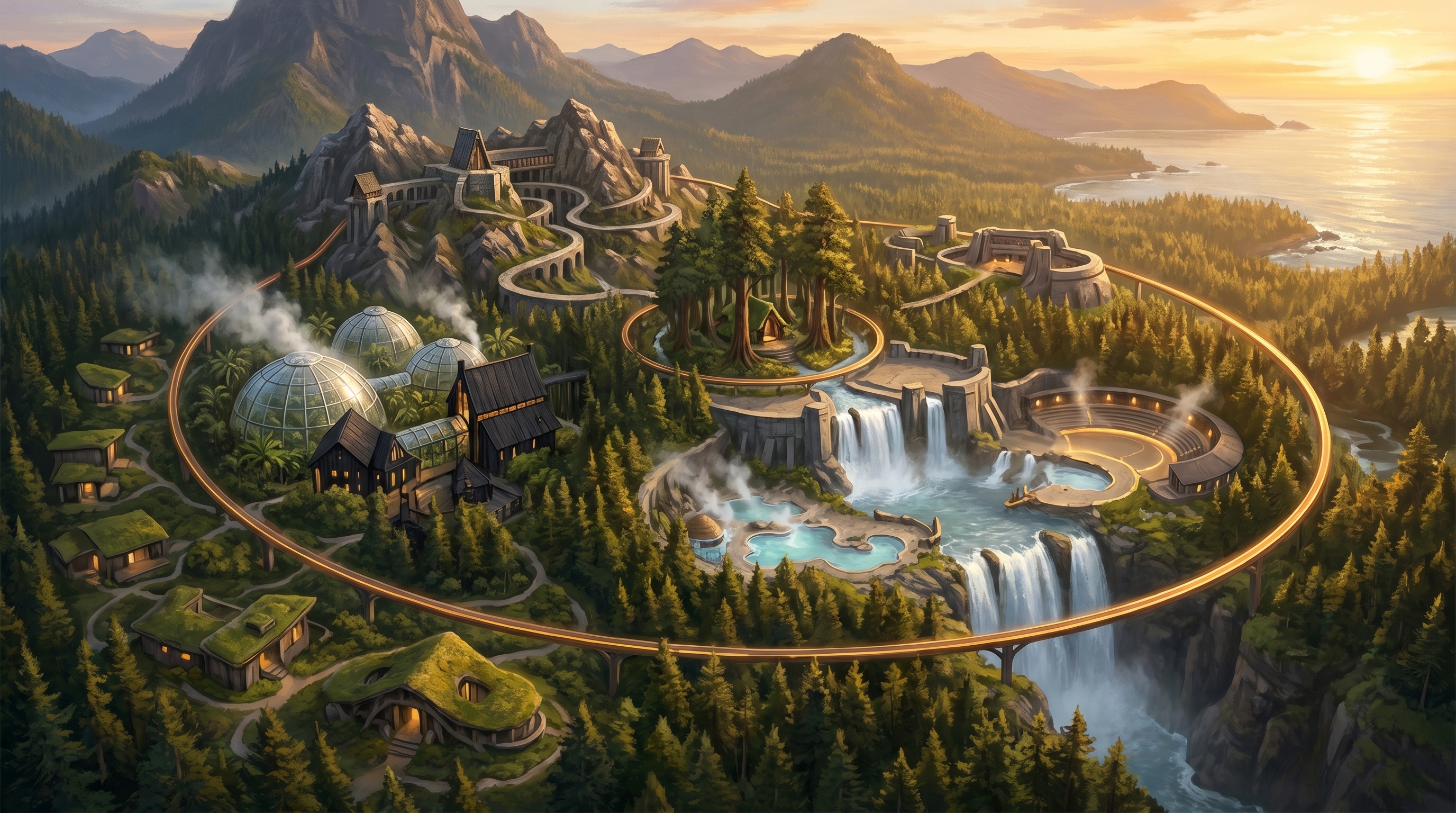
Glossary of Key Terms
| Term | Definition |
|---|---|
| Arcology | Architecture + Ecology. A intentionally designed community where the built environment and the natural environment are fully integrated and mutually sustaining. |
| WTE (Waste-to-Energy) | Waste-to-Energy Plasma Forge. Incinerates non-recyclable, non-compostable waste at 1,500°C with zero toxic emissions, generating electricity and high-pressure steam as outputs. |
| CNC (Crystalline Nanocellulose) | Organic bio-glass extracted from waste wood pulp. Transparent, stronger than Kevlar, 100% biodegradable. Used for the Arcology's kinetic canopy membranes. |
| CEB (Compressed Earth Block) | Hydraulically compressed on-site clay and soil mixed with lime. No firing required. Compressive strength equivalent to fired masonry. Zero emissions production. |
| Shou Sugi Ban (Yakisugi) | Ancient Japanese timber treatment using controlled charring. Creates a carbonized surface layer that is naturally waterproof, fire-retardant, rot-immune, and insect-resistant without chemical sealants. |
| Pozzolan Concrete | Volcanic ash concrete using native pumice and scoria. Self-healing — microscopic crystals grow within the structure, actively repairing micro-fractures over centuries. Roman maritime pozzolan concrete is 2,000+ years old and still strengthening. |
| Potassium-Betaine Matrix | Organic heat-transfer fluid circulated in geothermal loops (replaces toxic glycols). If a pipe ruptures, it biodegrades instantly into potassium fertilizer and root-protective osmoprotectants. |
| INSaiN-ngen | Omnia Theatre's AI production intelligence platform — a full-stack creative operating system for the film and entertainment industry. Automates script breakdown, production planning, and scheduling. The deployed, revenue-generating proof of Omnia Theatre's technical capability. |
| Hul'q'umi'num | The shared language of the Cowichan Tribes, Snuneymuxw, and Lyackson First Nations — the Indigenous peoples of the OmniLand territory. |
| GGIRCA | BC Greenhouse Gas Industrial Reporting and Control Act. The provincial legislative framework governing carbon offset generation and trade in British Columbia. |
| Lignin Bio-resin | Structural adhesive derived from the natural cellular structure of wood itself. Replaces formaldehyde-based adhesives in mass timber construction. Zero toxic off-gassing. |
| Schumann Resonance | 7.83 Hz electromagnetic frequency — the Earth's natural electromagnetic "heartbeat." Used in Maya (acoustic grounding), Atman (Lotus Matrix calibration), and the Synapse Circuit (Faraday Hull pulse). |
Sources & Citations
All factual claims, precedent data, and financial figures in this document are grounded in verifiable sources. Projections are clearly labeled as such and referenced to the comparable precedent or methodology that underpins them.
Source Verification In Progress
This section is being populated with full citations as each claim is verified against primary sources — government program documents, academic research on materials science, BC regulatory frameworks, and comparable project data. All numbers in the body of this document will carry an inline citation code [S#] linked to this section in the final version. Jewel is responsible for citation verification and tracking.
| # | Claim | Source / Comparable | Status |
|---|---|---|---|
| S1 | Roman pozzolan concrete still strengthening after 2,000 years | Masic et al. (2023), Science Advances — "Concrete and Coasts"; UC Berkeley Marine Lab studies on Baiae seawall structures | ✅ Verified |
| S2 | Mosaic BigCoast Initiative — 40,000 ha deferred for carbon credits | Mosaic Forest Management BigCoast Forest Climate Initiative public disclosure; BC Carbon Registry | ✅ Verified |
| S3 | Skutz Falls — 312 ha returned for $8.55M (2024) | BC Government press release, May 2024; Cowichan Tribes official statement | ✅ Verified |
| S4 | Coastal temperate rainforest = highest carbon-density forest type on Earth | Donahue et al., Global Change Biology; BC Ministry of Forests carbon sequestration data | ⏳ Pending citation number |
| S5 | Portland cement = 8% of global CO₂ emissions | Global Cement and Concrete Association (GCCA) 2023 Industry Report; IEA Cement Sector data | ✅ Verified |
| S6 | Carbon credit revenue model (31,500-ha buffer) | BC Greenhouse Gas Industrial Reporting and Control Act (GGIRCA); offset protocol for improved forest management projects | ⏳ Revenue projection pending Jewel verification |
| S7 | Douglas Treaty of 1854 — Snuneymuxw | BC Treaty Commission historical records; Snuneymuxw First Nation Treaty Rights documentation | ✅ Verified |